- Free Consultation: (954) 738-9757 Tap Here To Call Us




Avoid Probate in Florida: 7 Strategies That Actually Work


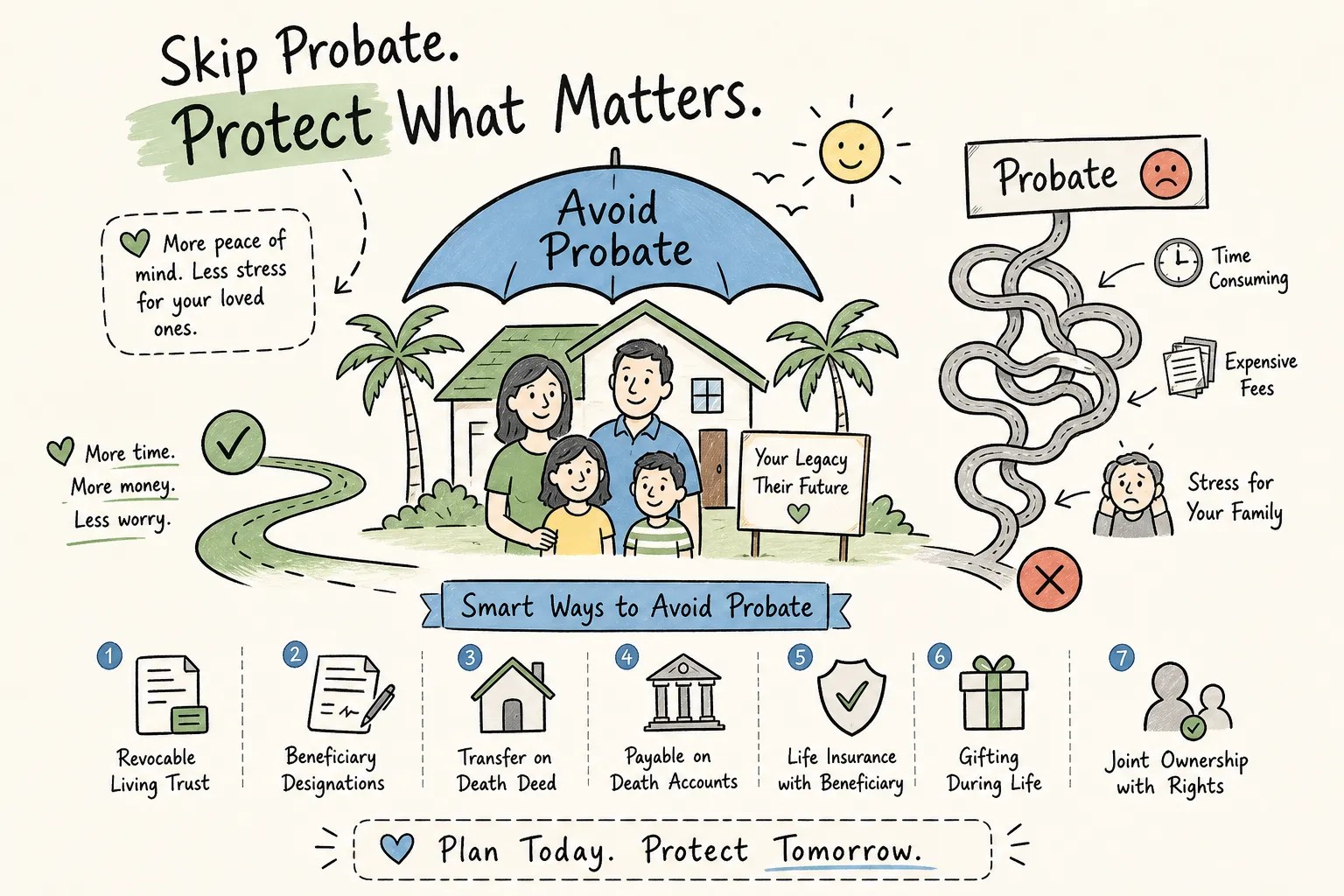
To avoid probate in Florida, many families rely on a core set of legal tools: revocable living trusts, Lady Bird deeds, coordinated beneficiary designations, payable-on-death and transfer-on-death accounts, joint ownership with right of survivorship, and Florida’s simplified administration options. The right strategy is not universal. It depends on your estate’s size, the types of assets you own, and your family’s specific circumstances. What works for a single retiree with one property looks very different from what a blended family with multiple properties and business interests needs. This article walks through each strategy clearly so you can identify which tools fit your situation and know exactly what to do next. At Hadeed Legal, a Coral Gables firm focused exclusively on probate, estate planning, and guardianship law, attorney Anwar Hadeed helps South Florida families work through these decisions every day.
Key takeaways
- Probate has real costs: Florida formal administration can take 6 to 24 months, and attorney and court fees can consume a significant portion of an estate’s value. On a $500,000 estate, those costs can easily reach tens of thousands of dollars before a single dollar reaches your family.
- Trusts must be funded: A revocable living trust only avoids probate for assets that are actually retitled in the trust’s name during your lifetime.
- Lady Bird deeds work differently: Florida has no statutory transfer-on-death deed for real estate; the Lady Bird deed is the recognized alternative, but homestead rules require careful attention.
- Beneficiary designations override wills: Retirement accounts, life insurance, and POD/TOD accounts pass to whoever is named on the form, regardless of what your will says.
- The 2026 threshold matters: For deaths on or after July 1, 2026, Florida summary administration applies when the non-exempt estate does not exceed $150,000 in assets subject to administration. For earlier deaths, the previous $75,000 limit applies.
- Life events require updates: Marriage, divorce, births, and deaths can all invalidate a plan that was perfectly structured the day you signed it.
What avoiding probate in Florida actually means for your family
Probate is the court-supervised process Florida uses to transfer a deceased person’s assets to heirs or beneficiaries. When assets must go through formal administration, the process typically runs 6 to 12 months for uncomplicated estates and can stretch to 24 months or more when disputes, creditor issues, or title problems arise. Attorney and court fees for formal administration vary widely depending on county, estate complexity, and the attorneys involved; on a substantial estate, those costs can reach tens of thousands of dollars before a single dollar reaches your family.
For deaths on or after July 1, 2026, formal administration applies when the non-exempt estate exceeds $150,000. For deaths before that date, the previous $75,000 threshold applies. Smaller estates may qualify for summary administration, which typically resolves in 4 to 8 weeks, or for even simpler procedures. But those options still involve court filings. The strategies covered below aim to keep assets out of the court process entirely.
The critical limitation to understand is this: assets titled solely in your name with no beneficiary designation will generally require probate, regardless of estate size or family structure. Florida’s constitutional homestead rules add another layer of complexity, particularly for married property owners. Planning that does not account for these realities can create the very delays it was meant to prevent.
The 7 strategies Florida families use to avoid probate
1. Revocable living trust
A revocable living trust avoids probate by retitling assets in the trust’s name during your lifetime. You typically remain the trustee and retain full control. After your death, a successor trustee distributes the trust assets according to the trust’s terms, bypassing the court entirely. For complex estates with multiple properties, business interests, or blended family dynamics, this is the most comprehensive tool available.
The single most important rule is funding. A trust that was drafted but never funded provides no probate-avoidance benefit for the assets left in your individual name. Funding means physically transferring ownership: recording a deed on real estate, retitling bank and brokerage accounts, and assigning business interests. Attorney-prepared trust plans in Florida typically cost between $1,500 and $5,000, with more complex estates sometimes exceeding that range depending on the number of properties, business interests, and the level of funding assistance required. The process generally takes one to several weeks for document preparation, with additional time for institutional transfers.
From attorney Anwar Hadeed: In my practice, I regularly see families who come to me after a loved one has died with a trust that was drafted but never funded. They expect that because the trust says particular assets go to particular people at particular times, that is all they need to have it enforced. It is not, and many people realize this only when it is already too late, after the grantor has died. In these situations the trust is effectively moot, because it does not actually own the assets. The consultation changes from a trust administration to a probate administration, because probate is the only way the beneficiaries can receive the assets that were never funded into the trust. Sometimes those beneficiaries are not even the people the decedent intended.
2. Lady Bird deed for Florida real estate
Florida has no statutory transfer-on-death deed for real property. The recognized alternative is the Lady Bird deed (also called an enhanced life estate deed), which lets you name a remainder beneficiary for your home while retaining full control during your lifetime. You can sell, mortgage, lease, or revoke the deed without the beneficiary’s consent. At your death, the property passes to the named beneficiary by operation of the deed. Beneficiaries typically record a death certificate along with an affidavit or other proof-of-death documentation in the county where the property is located, though mortgage status, homestead designations, or title history can sometimes require additional steps.
Lady Bird deeds are particularly valuable for Medicaid planning. Because no completed transfer occurs during your lifetime, the deed generally does not trigger a Medicaid transfer penalty, and Florida’s current estate-recovery framework cannot reach property that passes outside probate. Individual circumstances can vary, though, and an improperly structured plan may produce different results. One critical caution: Florida’s constitutional homestead protections apply to this deed. A married owner cannot use a Lady Bird deed to override a surviving spouse’s constitutional rights, and an improperly drafted deed can create title defects that surface years after your death.
3. Beneficiary designations on retirement accounts and life insurance
Retirement accounts, life insurance policies, annuities, and bank accounts designated as payable-on-death all pass directly to named beneficiaries outside probate. These beneficiary designations in Florida legally control over any instructions in your will. A beneficiary form completed 20 years ago can override an updated will signed last week.
The most common mistakes involve naming “my estate” as the beneficiary, which sends the asset straight into probate, failing to name contingent beneficiaries, or leaving an outdated name on file after a divorce or death. If a named beneficiary predeceases the account holder and no contingent beneficiary is on file, the asset may flow directly into the probate estate, exactly the outcome the designation was meant to prevent. Every major life event should trigger a review of every designation you have on file across every institution.
4. Transfer-on-death and payable-on-death accounts
Bank accounts and investment accounts can be designated to transfer automatically to a named beneficiary after death. The account passes outside probate when a surviving, properly named beneficiary is on file. Unlike a will, this designation takes effect immediately upon presentation of a death certificate, without court involvement. One planning note: if the named beneficiary dies before you and no contingent is listed, the account defaults to your estate and enters probate. These accounts work best as part of a coordinated plan rather than as a standalone solution.
5. Joint ownership with right of survivorship
Joint tenancy with right of survivorship and tenancy by the entireties (available to married couples) allow the deceased owner’s interest to pass automatically to the surviving owner. The title document must specifically establish survivorship rights; language that does not create survivorship may still result in probate for the deceased owner’s share.
This strategy works well for clear-cut situations, but it carries meaningful limitations. In blended-family arrangements, a surviving joint owner inherits the entire asset outright, with no obligation to share proceeds with the deceased owner’s children from a prior relationship. Joint ownership also exposes all co-owners to each other’s creditors during their lifetimes. For example, if one joint owner faces a lawsuit or judgment, the shared asset may be reachable. These are important considerations before adding anyone’s name to a deed or account.
6. Summary administration for qualifying estates
Summary administration is not a full probate-avoidance strategy, but it significantly shortens the court process. For deaths on or after July 1, 2026, it applies when the non-exempt Florida estate does not exceed $150,000 in assets subject to administration ($75,000 for deaths before that date), or when the decedent has been deceased for more than two years regardless of value. The process typically resolves in 4 to 8 weeks compared to 6 to 12 months for formal administration. It does not transfer real estate in most circumstances, and it still requires court filings.
7. Disposition without administration for very small estates
For the smallest estates, those where the only non-exempt assets are amounts needed to cover qualifying funeral costs and final-illness expenses, Florida’s disposition without administration procedure may apply. The non-exempt personal property limit under current law is $20,000. Eligibility rules are narrower than many people expect: the procedure does not generally apply if there is a pending administration, and will-related requirements may apply as well. This is the closest Florida comes to a true small-estate affidavit, but it does not generally transfer real estate, and forms and procedures vary by county.
Which strategy fits your situation
The table below offers a quick comparison of how to avoid probate in Florida based on common family situations.
| Situation | Best-fit strategy | Court involvement at death |
|---|---|---|
| Estate under $150,000 in non-exempt assets (death on or after July 1, 2026; $75,000 before), or decedent deceased 2+ years | Summary administration (distinct from disposition without administration, which has narrower eligibility) | Minimal; simplified court process |
| Single Florida property, straightforward family structure | Lady Bird deed plus updated beneficiary designations | None at death if properly executed |
| Multiple properties, blended family, or business interests | Revocable living trust with pour-over will | None if fully funded during lifetime |
| Retirement and financial accounts primarily | Coordinated beneficiary designations with POD/TOD accounts | None for properly designated assets |
| Medicaid planning concern with Florida homestead | Lady Bird deed (may offer stronger protection than a revocable trust for estate-recovery purposes) | None if properly drafted and recorded |
For families whose primary asset is a Florida home combined with retirement accounts and financial accounts, a Lady Bird deed on the real estate paired with carefully updated beneficiary designations can keep the entire estate outside probate without the cost of a full trust. This works best when family circumstances are clear-cut, there are no minor children as direct beneficiaries, and Medicaid planning is not yet a pressing concern.
When an estate includes multiple properties, business interests, or blended family dynamics, a revocable living trust provides the most thorough solution. It also addresses incapacity during your lifetime, allowing a successor trustee to manage assets if you become unable to do so. A Lady Bird deed and beneficiary designations do not provide that benefit.
What quietly sends assets back to probate court
Even a well-designed plan can fall apart at the implementation stage. An unfunded trust is one of the most common and costly estate-planning mistakes in Florida. Families pay to have a trust drafted, sign the documents, and then never retitle their assets. Years later, those assets require full probate because they were never transferred to the trust. The documents alone accomplish nothing without the funding step.
Outdated beneficiary designations are a close second. An ex-spouse, a deceased parent, or a name left unchanged on a form from two decades ago can legally inherit a retirement account or life insurance policy regardless of what a will says. Florida law does not automatically remove a former spouse as a beneficiary on a retirement account governed by federal law; the institution must receive a new form. Review every designation after every major life event.
Homestead complications catch people off guard more than almost anything else in Florida estate planning. A Lady Bird deed on a married couple’s homestead that does not account for the surviving spouse’s constitutional rights can create title defects that take years and thousands of dollars to resolve. Joint ownership arranged without proper survivorship language can leave the deceased owner’s share in probate. These are fact-specific issues that depend on exactly how title was structured and when.
How Hadeed Legal helps South Florida families choose the right plan
Avoiding probate in Florida involves state-specific statutes, constitutional homestead rules, county recording requirements, and Medicaid considerations that general national resources routinely get wrong. A Lady Bird deed drafted without accounting for homestead restrictions, or a trust that was signed but never funded, can create the exact problems it was designed to prevent. The difference between a properly implemented plan and one that looks right on paper is often what determines whether your family spends months in probate court.
At Hadeed Legal, attorney Anwar Hadeed begins every client relationship with a free consultation to understand the family’s assets, goals, and concerns before recommending any strategy. The firm focuses exclusively on probate, estate planning, and guardianship law, which means every recommendation is grounded in current Florida law and the specific circumstances that affect how each tool performs in practice. Whether the right answer is a Lady Bird deed, a revocable living trust, a beneficiary update, or a combination of all three, the firm helps families implement the plan correctly, not just put documents on paper.
The right plan is one you actually complete
Keeping your estate out of Florida probate court is entirely achievable. Revocable living trusts, Lady Bird deeds, coordinated beneficiary designations, and joint ownership arrangements all give Florida families dependable options suited to a range of situations. The right tool depends on what you own, who inherits it, and the complexity of your family’s circumstances. None of these strategies work on autopilot. Life changes, and an estate plan needs to keep up with it.
To avoid probate in Florida, you have to complete the funding and recording steps described above, and then revisit your plan after every significant life change. The worst outcome is a plan that stalls partway through. Gaps like these cost families far more than the planning itself ever would have.
If you have been putting this off, consider this the reason to act now, while it is still a choice rather than a crisis. Reach out to Hadeed Legal to schedule a free consultation. A conversation today can spare your family a drawn-out court process, unnecessary costs, and uncertainty during an already difficult time. That is the most direct act of care you can offer the people you love.
Related articles
- Transfer on Death in Florida: Which Accounts Qualify
- Florida Will vs. Trust: Which Is Right for Your Estate?
- Miami Probate Steps: From Filing to Final Distribution
Frequently asked questions
You should review your beneficiary designations after every major life event. Marriage, divorce, births, and deaths can all invalidate a plan that was perfectly structured the day you signed it, and an outdated designation can send an asset into probate or to someone you no longer intend to inherit.
No, a revocable living trust only avoids probate for assets that are actually retitled in the trust’s name during your lifetime. A trust that was drafted but never funded provides no probate-avoidance benefit, so you must record deeds, retitle accounts, and assign interests to the trust to get the intended result.
If a trust was drafted but never funded, it generally does not control the assets left in the decedent’s individual name. Those assets will usually need to go through probate administration, and they may pass under the will or Florida’s intestacy rules rather than the trust’s terms.
A properly structured Lady Bird deed generally does not trigger a Medicaid transfer penalty and often passes property outside probate so Florida’s current estate-recovery framework cannot reach it. However, individual circumstances can vary, and Florida’s constitutional homestead protections and title issues mean careful drafting is required to achieve those benefits.
Joint ownership can avoid probate but exposes the asset to the co-owner’s creditors and may unintentionally disinherit children from a prior relationship. In blended-family situations, a surviving joint owner inherits the entire asset outright, and survivorship language must be correct or the deceased owner’s share may still end up in probate.