- Free Consultation: (954) 738-9757 Tap Here To Call Us




Transfer on Death in Florida: Which Accounts Qualify


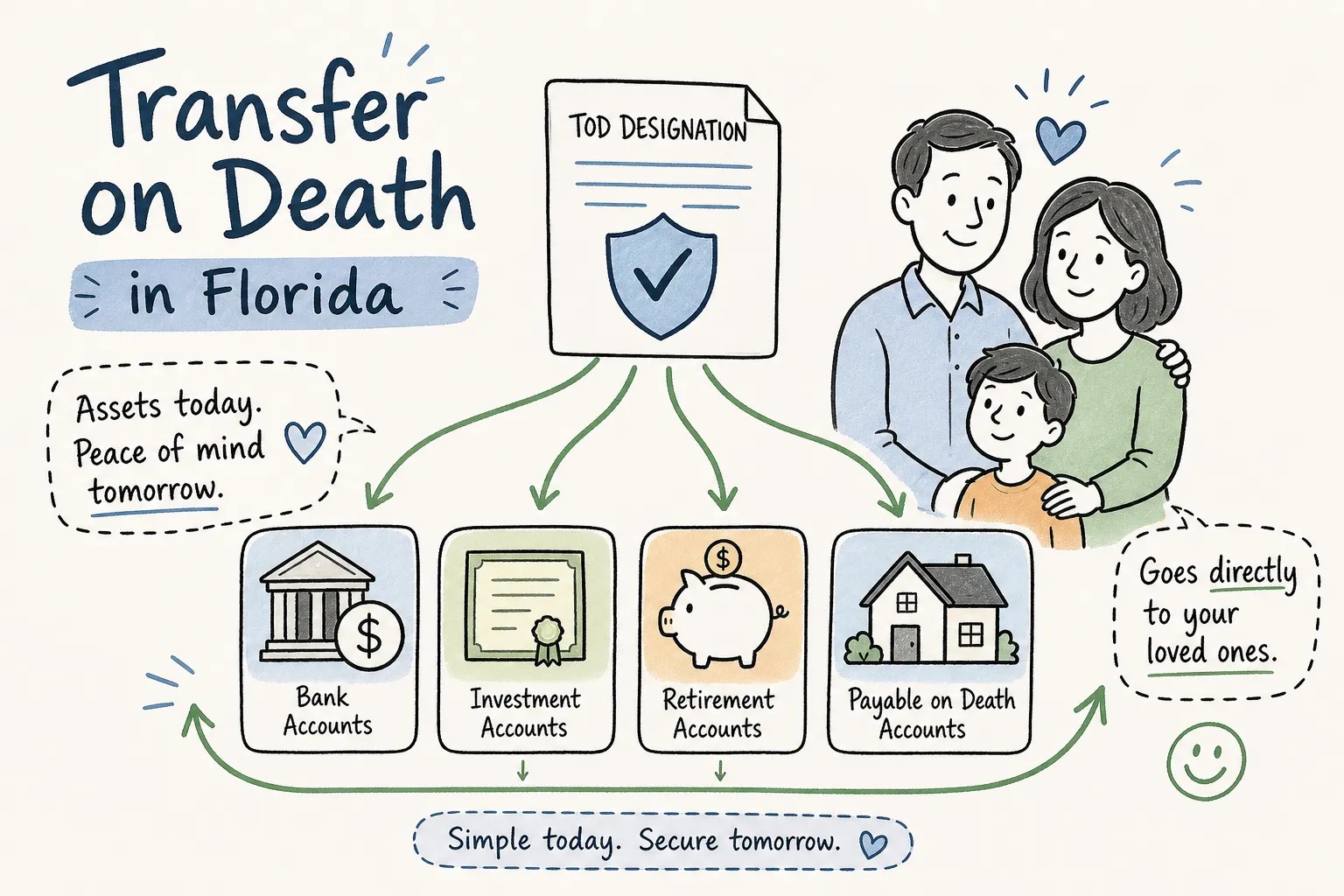
Florida does recognize transfer-on-death designations, but only for specific asset types. Bank accounts, brokerage accounts, and motor vehicles can pass directly to a named beneficiary outside of probate using TOD or payable-on-death (POD) designations. Real estate is a different story entirely, and understanding that distinction up front can save your family a costly surprise. This guide covers exactly which Florida assets qualify, how the setup works, and where these designations leave gaps that a broader estate plan needs to fill.
The coordination between designations, wills, and trusts is where families most often go wrong, and getting that coordination right is the difference between a smooth transfer at death and an unexpected trip to probate court.
Key takeaways
- TOD covers accounts, not land: Florida recognizes TOD and POD designations for bank and brokerage accounts but has not adopted a transfer-on-death deed for real estate.
- A will alone does not avoid probate: Even when your wishes are clear, an account with no beneficiary designation will generally still go through probate.
- Vehicles have their own process: A surviving spouse, co-owner, or heir can transfer a vehicle title through the county tax collector’s office, often without probate documents.
- Designations override your will: A TOD or POD form controls regardless of what your will says, so outdated designations can send assets to the wrong person.
- Minors and disabled beneficiaries need extra protection: These designations transfer assets outright, which can disqualify a disabled heir from benefits or deliver a lump sum to an 18-year-old.
- A trust covers what designations cannot: Real estate, business interests, and coordinated multi-asset distribution require a revocable living trust, not just a designation form.
- Medicaid recovery is typically limited to probate estates: Florida’s estate recovery process is usually probate-focused, but specific account structure and family circumstances matter.
What does a transfer-on-death designation actually cover in Florida?
How transfer on death in Florida works for bank accounts
Florida bank accounts use POD language rather than TOD, but the mechanics are identical: the account passes directly to the named beneficiary on proof of death, bypassing probate entirely. This transfer is governed by Florida Statutes § 655.82 and the account contract itself, not a deed or court order. The beneficiary has zero access while you are alive. They cannot withdraw funds, receive statements, or change anything about the account until you pass.
A joint account with right of survivorship works similarly but carries different implications during your lifetime. A co-owner on a joint account can access and withdraw funds while you are still living, which a POD beneficiary cannot. For many families, a POD designation offers cleaner control.
Brokerage accounts and TOD registration
Non-retirement investment and brokerage accounts may be registered with a Transfer-on-Death (TOD) beneficiary designation pursuant to Sections 711.50 through 711.512, Florida Statutes, known as the Florida Uniform Transfer-on-Death Security Registration Act. These provisions govern the transfer of securities and qualifying investment accounts, not real property.
Upon the account owner’s death, ownership of the securities or account passes to the surviving designated beneficiary, and the financial institution may transfer or reregister the account in the beneficiary’s name upon receipt of proof of death and satisfaction of its applicable documentation requirements.
During the owner’s lifetime, the designated beneficiary has no ownership interest in or control over the account solely by virtue of the TOD designation. The owner retains the right to manage the account and change or revoke the beneficiary designation at any time.
This arrangement is distinct from retirement accounts, such as IRAs and 401(k) plans, which generally transfer pursuant to their own beneficiary designation provisions and applicable federal and state laws rather than Florida’s TOD securities registration statute.
What TOD does not cover: real estate
Florida has not adopted a transfer-on-death deed for real property. Some Florida homeowners search for a beneficiary deed or transfer-on-death deed for real estate, but no such instrument exists under Florida law. The comparable tool for real estate is an enhanced life estate deed, commonly called a Lady Bird deed, or a revocable living trust. Both are separate instruments that require careful drafting. A deed labeled “transfer-on-death” or “beneficiary deed” has no legal effect on Florida real estate, which is why relying on one without attorney guidance is a serious risk.
How transfer on death in Florida works for bank and brokerage accounts
You don’t necessarily need an attorney, a trust, or an expensive legal document. For an eligible bank account, you may simply need to contact your bank and ask to add a payable-on-death (POD) beneficiary. Many banks offer this service free of charge.
A hypothetical: same mom, same money, two different results
Mom passes away leaving $60,000 in a savings account for her two adult children. She has a will stating that everything should go to them, but she never designated beneficiaries on the account. Even though her wishes are clear, her children will still need to go through probate to access the money, and that costs them money.
Now imagine mom had taken a few minutes to add her children as POD beneficiaries at her bank. Assuming the designation was valid and both children survived her, the account generally could have passed directly to them without probate.
Same mom. Same money. Same intended beneficiaries. But two potentially very different results.
From attorney Anwar Hadeed: As a Florida probate attorney, one of the most important things I want families to understand, and what I believe is the number one misconception my clients have before speaking to me, is that a will does not automatically keep your assets out of probate. My advice is to check your checking accounts, savings accounts, and certificates of deposit. Ask your bank whether each account has an active POD designation, and request written confirmation. It is a simple step that could spare your loved ones so many unnecessary complications. And remember, avoiding probate on one bank account does not mean your entire estate will avoid probate. Other assets will likely require additional planning.
Adding a POD beneficiary to a bank account
The process is straightforward: visit your bank in person or through its online portal, request a POD or beneficiary designation form, and provide your beneficiary’s full legal name, date of birth, and Social Security number. Florida Statutes § 655.82 governs the designation itself, but procedures differ, so check with your bank about its specific form and documentation policy. Sign the form and ask for written confirmation that the designation is on file. No attorney, no court filing, and no public recording is required. The beneficiary gains no access to your account while you are alive.
Registering a TOD beneficiary on a brokerage account
Most Florida brokerage firms offer TOD registration under Chapter 711 through an online portal or a paper form. You name primary beneficiaries and, importantly, contingent (backup) beneficiaries. Naming a contingent beneficiary is one of the most overlooked steps in estate planning. If your primary beneficiary predeceases you and no backup is named, the account has no valid designation at your death. It becomes a probate asset, subject to the delays and costs of Florida’s court process. Specific brokerage procedures vary by institution, so confirm the process directly with your firm. Review your designations after every major life event: marriage, divorce, the birth of a child, or the death of a named beneficiary.
Keeping designations current and coordinated
A TOD or POD designation overrides your will. If your will leaves your brokerage account to your daughter but the TOD form still names your son, your son receives the account. This is one of the most common and preventable estate planning mistakes in Florida. These designations are not a set-it-and-forget-it tool; they need a periodic review, particularly after any change in your family or financial situation.
From attorney Anwar Hadeed: As a Florida probate attorney, I have seen far too many beneficiary designations fail simply because they were never updated. Under Florida law, a designation naming a former spouse generally becomes void upon divorce, subject to certain exceptions. Similarly, if your designated beneficiary passes away before you and no other beneficiary survives, the account may end up in your estate and require probate, the very process you intended to avoid. My advice is simple: review your beneficiary designations after major life events, especially a marriage, divorce, or death in the family. A few minutes of planning today could save your loved ones significant time, money, and frustration later.
What happens to a vehicle when the owner dies in Florida?
Surviving spouse: a straightforward transfer
A surviving spouse can transfer a Florida vehicle title without probate documents by submitting Form HSMV 82152 to a county tax collector’s office or authorized tag agency. You will also need a certified death certificate, valid photo ID, and a marriage certificate if the surviving spouse’s name does not appear on the death certificate. No court order or will is required. An expedited title is available for an additional $10 fee, and because no probate proceeding is involved, this is one of the more practical transfers Florida law provides. Confirm current form requirements with your county tax collector’s office or the Florida Department of Highway Safety and Motor Vehicles, as procedures can be updated.
Surviving co-owner or heir
A co-owner generally submits the original Florida title, a certified death certificate, valid ID, and Form HSMV 82040. An heir follows a similar process but may also need a copy of the will if one exists, along with applicable probate documents such as Letters of Administration. If the owner died without a will and the estate is not indebted, Florida law may allow an heir to transfer the title using an affidavit process that avoids a full probate proceeding entirely.
What if the vehicle was titled solely in the decedent’s name?
A solely owned vehicle with no co-owner or surviving spouse on the title is a probate asset in Florida. The personal representative must obtain the title or apply for a duplicate using Form HSMV 82101 if it is missing, complete the transfer section, and provide Letters of Administration to the county office. This is exactly why many Florida families move vehicle titles to joint survivorship ownership before a loved one’s health begins to decline. A brief conversation with an estate planning attorney can identify which titled assets in your household carry this risk.
Where do TOD designations fall short?
Minors and vulnerable beneficiaries can’t receive funds directly
A TOD or POD designation transfers assets to the named person outright and immediately at death. A minor child legally cannot hold those funds, and a court may appoint a guardian to manage the money until the child turns 18, at which point they receive everything at once with no restrictions. A beneficiary with a disability faces a different but equally serious problem: receiving a lump-sum inheritance can disqualify them from SSI or Medicaid benefits. These designations provide no spendthrift protection, no payout schedule, and no ongoing oversight. For families with minor children or a disabled heir, a designation alone is not enough.
Designations can conflict with your estate plan
If a TOD account passes outside the probate estate, it cannot be used to pay estate debts, equalize inheritances across heirs, or fund a special-needs trust. A family might carefully draft a trust to protect a disabled child, only to find that a TOD account bypasses the trust entirely and delivers the funds directly to the child. Coordination between designation forms, wills, and trusts does not happen automatically. It requires intentional planning, ideally with an attorney who reviews the full picture rather than one document at a time.
Creditors, Medicaid, and tax issues don’t disappear
Avoiding probate is not the same as protecting assets. TOD accounts can still be reached by the beneficiary’s creditors after the transfer occurs. Florida Medicaid estate recovery is generally focused on the probate estate, so a properly designated TOD account usually passes outside its reach. That said, account structure, beneficiary status, and homestead rules all affect the outcome, and an elder law or probate attorney should confirm how your accounts interact with Medicaid eligibility before you rely on a designation as your primary planning tool.
TOD vs. a revocable living trust: which one does more for your family?
What a living trust covers that TOD can’t
A revocable living trust can hold virtually any Florida asset: bank accounts, brokerage accounts, real estate, business interests, and personal property. It provides a single coordinated plan rather than a patchwork of individual designation forms. It also handles incapacity. If you become unable to manage your finances, the successor trustee steps in immediately without a court proceeding. TOD designations offer no incapacity protection at all, a meaningful gap for anyone concerned about the years before death, not just the moment of it.
From attorney Anwar Hadeed: What I always advise my clients is that yes, you can add a TOD or POD designation, and it could all work out if nothing unanticipated happens. But life is unpredictable. A minor may inherit significant assets directly, which would trigger a guardianship. The designated person may be an ex-wife or ex-husband. They may be incapacitated, or they may have died before you, and your estate still lands in probate because of it. A revocable trust can account for and prepare your estate for hundreds of unpredictable possibilities. That is where a TOD or POD designation falls short.
When TOD designations still make sense alongside a trust
TOD and POD designations are not necessarily replaced by a trust; they can complement one another. A family might hold their primary brokerage account inside a trust while using POD designations on smaller bank accounts they have not yet retitled. The goal is ensuring every asset has a clear, intentional path at death. Gaps, whether from an account never retitled into the trust or a vehicle titled in one spouse’s name only, are what send families to probate court unexpectedly.
Closing the gaps with a coordinated estate plan
This is where the real planning work happens. At Hadeed Legal, we help Florida families map every asset, identify which ones pass through TOD or POD designations, which need to be held in trust, and which require a deed update. Then we coordinate all of it into a single, consistent estate plan. A designation alone is a tool. A complete plan is what makes it work as intended, for the right people, in the right amounts.
A TOD designation is a starting point, not a finish line
Transfer-on-death designations work well in Florida for bank accounts, brokerage accounts, and vehicles. They are among the simplest probate-avoidance tools available, and for many families they handle a meaningful portion of the estate without any court involvement. But no single tool covers everything. Real property requires a Lady Bird deed or a trust. Minors and vulnerable beneficiaries need additional protections. And designations that have not been reviewed in years can quietly undo even a well-drafted will.
The families who avoid probate court, inheritance disputes, and unintended distributions are not the ones who found the perfect designation form. They are the ones who sat down with an attorney, identified every gap, and built a plan that accounts for all of it. If your estate includes real estate, a blended family, a disabled heir, or simply accounts you have not reviewed in several years, that conversation is the right next step.
Hadeed Legal works with Miami-area families to clarify exactly where they stand and what steps make sense for their situation. Reach out to our team to get started.
Related articles
- Avoid Probate in Florida: 7 Strategies That Actually Work
- Florida Will vs. Trust: Which Is Right for Your Estate?
- Miami Probate Steps: From Filing to Final Distribution
Frequently asked questions
No, a named TOD or POD beneficiary has no access or control while you are alive. A beneficiary cannot withdraw funds, receive statements, or change the account. A joint account with right of survivorship is different because a co-owner can access funds during your lifetime.
Yes. A will does not keep a bank account out of probate. If the account has no POD beneficiary, your family will generally need to go through probate to access it, even when your will clearly names who should inherit.
No, adding a POD to a bank account requires no attorney, court filing, or public recording, and most brokerages provide TOD registration through their forms or portals. That said, coordinating designations with wills, trusts, and titled assets often benefits from attorney review to avoid unintended gaps or conflicts.
If no contingent beneficiary is named and the primary beneficiary predeceases you, the account has no valid designation at your death and becomes a probate asset. That subjects the account to Florida’s probate process, with the resulting delays and costs that designations usually avoid.
No, a TOD or POD designation does not protect a disabled beneficiary’s public benefits and can disqualify them by delivering a lump-sum inheritance. For disabled heirs, a revocable trust or other planning tools are necessary to provide spendthrift protection and preserve eligibility.